How eWomen nurtures Sierra Leone’s next generation of entrepreneurs
The morning sun filters through blue curtains branded with the eWomen logo, casting soft light across the co-working space in Makeni. Laptops hum, conversations overlap in English and Krio, and the air buzzes with ideas. Here, in this modest but lively hub, Sierra Leonean women have created a place where problems get solved.
3 MIN READ
success story
Sierra Leone
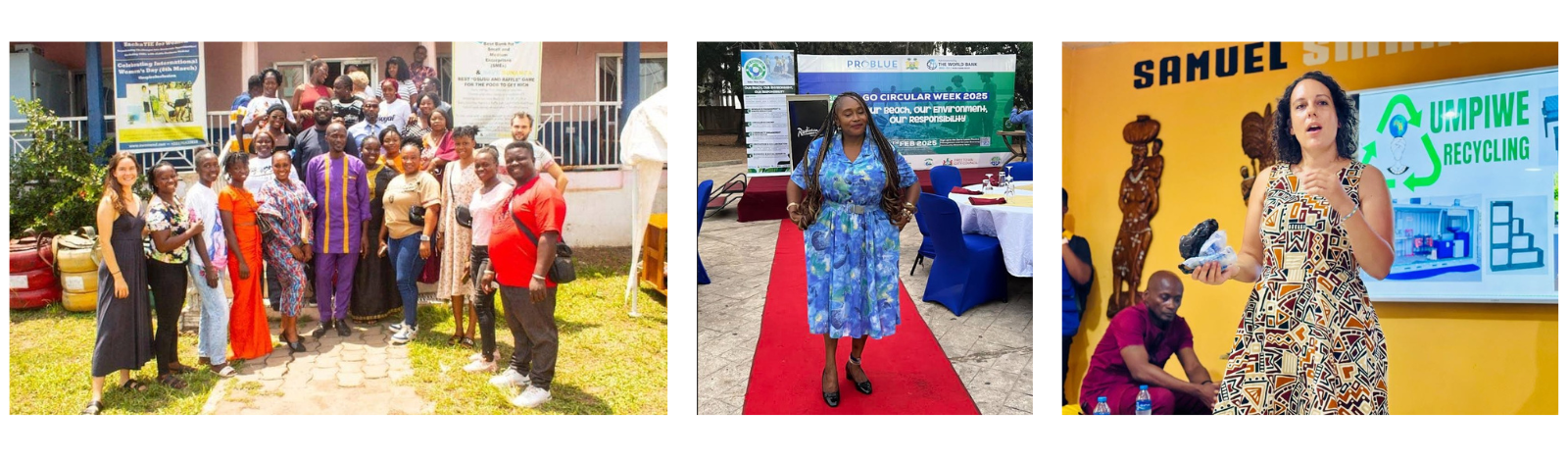
1 DECEMBER 2025
From litter patrols to innovation hub
When Kisimi Kayleemasa Kamara returned to Makeni in 2018 after 20 years working abroad, disappointed by the state of his former neighbourhood, he would walk the streets collecting litter.
‘Some people said I was mentally ill, even that I had been deported,’ he recalls with a laugh. ‘But the first people who joined me on my mission to clean up were women. Five or six joined me every morning.’
The initial group of women turned into eWomen. The hub is a place where women can tackle problems through innovation – recycling waste into new products, launching enterprises and building networks of support.
On any given afternoon, the hub feels like a living workshop. Around one desk, a group of women crowd over a grant application, pens tapping. Across the room, a mentor leans in, coaching a young founder on how to sharpen her pitch.
At the back, Dr. Sarah Luc from Belgium is developing plans to turn the healthcare centre where she works into a self-sustaining resource. Alongside working as a doctor, she is in the process of establishing a recycling factory in Makeni that will transform plastic waste into tiles and furniture. The profit will help finance healthcare services for women and children, while creating jobs for marginalized women, including sex workers. eWomen is providing guidance and technical support. ‘It’s been incredible to see how these two parts of myself – doctor and entrepreneur – can work with one another,’ Dr. Luc says.
Nearby, Agnes Gbla balances a notebook on her lap. With training and guidance from her peers at eWomen, she launched Win and Save to help women access finance. She now serves 50 women-led businesses. ‘When I came to eWomen, I felt loved. I felt included,’ she says. ‘That is what I want to pass on to others.’
At a corner table, Abibatu Kanu scrolls through photos of playgrounds she has upcycled from discarded tyres. With seed capital from an eWomen pitch competition, she secured a production space and a growing client base. ‘People burn waste tyres every day without knowing how it can damage our health and environment,’ she says. ‘I wanted to show that what we throw away can become something valuable.’
And moving from desk to desk, Beatrice Edwina Peroma, co-founder of eWomen, stitches the room together with quiet leadership. Once at the front of the litter patrols, she has since launched MESH, a skills hub for women, youth, and people with disabilities. ‘We bring problems together, and then we solve them together,’ she says. ‘That’s the way we do things here.’
Their projects illustrate Kisimi’s ethos for the hub: ‘You should not start a business. You should solve a problem. The business comes second.’
‘Some people said I was mentally ill, even that I had been deported,’ he recalls with a laugh. ‘But the first people who joined me on my mission to clean up were women. Five or six joined me every morning.’
The initial group of women turned into eWomen. The hub is a place where women can tackle problems through innovation – recycling waste into new products, launching enterprises and building networks of support.
On any given afternoon, the hub feels like a living workshop. Around one desk, a group of women crowd over a grant application, pens tapping. Across the room, a mentor leans in, coaching a young founder on how to sharpen her pitch.
At the back, Dr. Sarah Luc from Belgium is developing plans to turn the healthcare centre where she works into a self-sustaining resource. Alongside working as a doctor, she is in the process of establishing a recycling factory in Makeni that will transform plastic waste into tiles and furniture. The profit will help finance healthcare services for women and children, while creating jobs for marginalized women, including sex workers. eWomen is providing guidance and technical support. ‘It’s been incredible to see how these two parts of myself – doctor and entrepreneur – can work with one another,’ Dr. Luc says.
Nearby, Agnes Gbla balances a notebook on her lap. With training and guidance from her peers at eWomen, she launched Win and Save to help women access finance. She now serves 50 women-led businesses. ‘When I came to eWomen, I felt loved. I felt included,’ she says. ‘That is what I want to pass on to others.’
At a corner table, Abibatu Kanu scrolls through photos of playgrounds she has upcycled from discarded tyres. With seed capital from an eWomen pitch competition, she secured a production space and a growing client base. ‘People burn waste tyres every day without knowing how it can damage our health and environment,’ she says. ‘I wanted to show that what we throw away can become something valuable.’
And moving from desk to desk, Beatrice Edwina Peroma, co-founder of eWomen, stitches the room together with quiet leadership. Once at the front of the litter patrols, she has since launched MESH, a skills hub for women, youth, and people with disabilities. ‘We bring problems together, and then we solve them together,’ she says. ‘That’s the way we do things here.’
Their projects illustrate Kisimi’s ethos for the hub: ‘You should not start a business. You should solve a problem. The business comes second.’
A change in direction: ITC READY Salone
The hub’s impact was clear from early on, but a larger question remained: how could eWomen sustain itself beyond donor support?
In May 2025, Kisimi joined a week-long training in Freetown that was delivered by the ITC READY Salone project. The training focused on helping BSOs develop monetizable, demand-driven services to reduce donor dependency.
‘Kisimi was there every single day,’ recalls Tonia Dabwe, the ITC expert who led the training and subsequent coaching programme. ‘He fully embraced the concept because it offered him a tangible way to develop eWomen’s financial sustainability. We worked on designing services that people would actually pay for.’ By the end of the week, he had worked out his initial idea for ePass – a subscription model for access to the hub’s services.
After three months of tailored ITC coaching back in Makeni, Kisimi piloted ePass with a modest target of five university students. The coaching focused on testing and refining the model for various audiences and exploring ways for ePass to be scaled sustainably. Within weeks, 12 had signed up – more than double his expectations. ‘The response was a confirmation,’ he says. ‘It showed me we were on the right track. We could actually become a self-sustaining organization.’ During the pilot, Kisimi went on to develop two additional monetizable services that were also well received by distinct audiences.
Despite this progress, infrastructure holds eWomen back.
‘I am careful not to advertise ePass too widely,’ Kisimi admits. ‘I’m a lecturer at the university – if students all came at once, we wouldn’t have enough computers for them. If I just had more computers, we could expand ePass and its digital learning centre – imagine how many more young people we could reach.’
Infrastructure might be a hurdle, but for eWomen, obstacles have always been starting points. In Makeni, where power cuts and limited resources could easily halt progress, innovation becomes the current that keeps things moving. ‘In Sierra Leone, we learn to build bridges with what he have,’ Kisimi says. ‘If the road isn’t there, we make a path.’ That resourceful spirit – combined with the strategic and financial frameworks introduced during the ITC training and coaching programme – continues to guide eWomen’s evolution toward financial sustainability.
In May 2025, Kisimi joined a week-long training in Freetown that was delivered by the ITC READY Salone project. The training focused on helping BSOs develop monetizable, demand-driven services to reduce donor dependency.
‘Kisimi was there every single day,’ recalls Tonia Dabwe, the ITC expert who led the training and subsequent coaching programme. ‘He fully embraced the concept because it offered him a tangible way to develop eWomen’s financial sustainability. We worked on designing services that people would actually pay for.’ By the end of the week, he had worked out his initial idea for ePass – a subscription model for access to the hub’s services.
After three months of tailored ITC coaching back in Makeni, Kisimi piloted ePass with a modest target of five university students. The coaching focused on testing and refining the model for various audiences and exploring ways for ePass to be scaled sustainably. Within weeks, 12 had signed up – more than double his expectations. ‘The response was a confirmation,’ he says. ‘It showed me we were on the right track. We could actually become a self-sustaining organization.’ During the pilot, Kisimi went on to develop two additional monetizable services that were also well received by distinct audiences.
Despite this progress, infrastructure holds eWomen back.
‘I am careful not to advertise ePass too widely,’ Kisimi admits. ‘I’m a lecturer at the university – if students all came at once, we wouldn’t have enough computers for them. If I just had more computers, we could expand ePass and its digital learning centre – imagine how many more young people we could reach.’
Infrastructure might be a hurdle, but for eWomen, obstacles have always been starting points. In Makeni, where power cuts and limited resources could easily halt progress, innovation becomes the current that keeps things moving. ‘In Sierra Leone, we learn to build bridges with what he have,’ Kisimi says. ‘If the road isn’t there, we make a path.’ That resourceful spirit – combined with the strategic and financial frameworks introduced during the ITC training and coaching programme – continues to guide eWomen’s evolution toward financial sustainability.
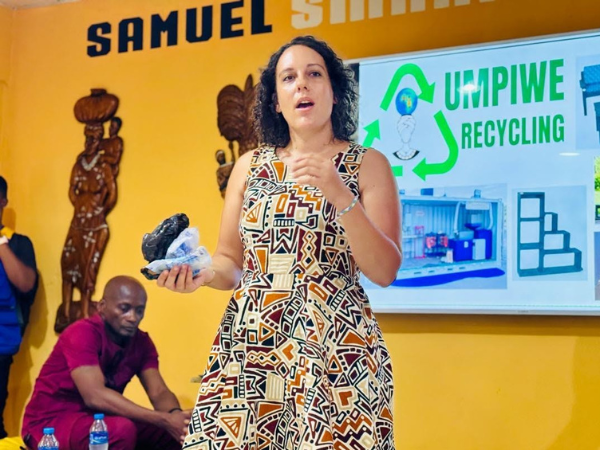
Makeni, Sierra Leone – Dr. Luc won second place at a pitch competition, setting her up to move ahead with her recycling factory.
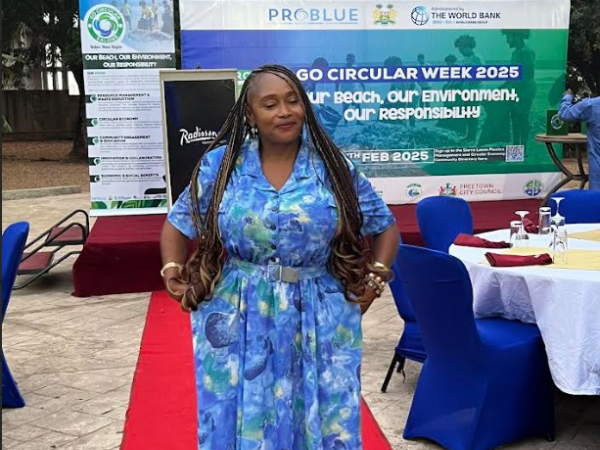
Makeni, Sierra Leone – eWomen co-founder, Beatrice Edwina Peroma, has gone on to set up another innovation hub to reach more youth, women and people with disabilities.

Makeni, Sierra Leone – With eWomen’s support, Abibatu Kanu has turned trash into playtime.
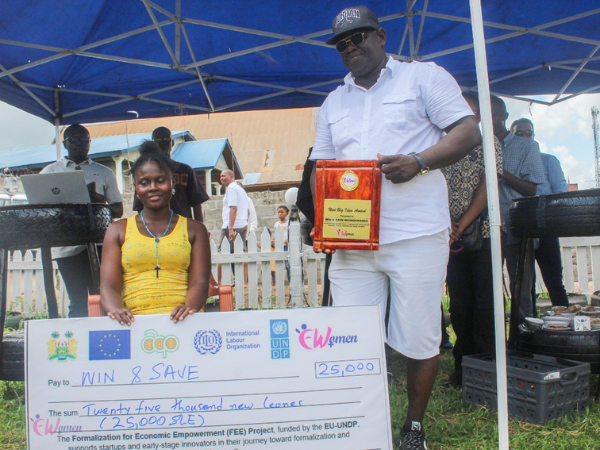
Makeni, Sierra Leone – Agnes Gbla’s pitch competition win allowed her to get Win and Save off the ground, and now she has supported 50 women-led businesses with microfinancing.
In Sierra Leone, we learn to build bridges with what he have. If the road isn’t there, we make a path.