‘We don’t just farm for ourselves anymore. We farm for markets.’
Across five districts of northern Uganda, women who once farmed for subsistence are now farming to sell. Five women from an ITC project show what made the difference.
3 MIN READ
success story
Uganda
12 AUGUST 2026
For years, Jackline Apidi grew sorghum, millet and maize on her land in Agago District. The crops fed her family and left nothing extra to sell. Millions of women across Uganda farm the same way: they make up more than half the country’s agricultural workforce, and in many households do more of the field work than men, yet they have long been kept out of the markets that turn a harvest into an income.
In 2026, the United Nations marks the International Year of the Woman Farmer, and one of the gaps it was created to spotlight is this: women feed nations but rarely earn from the markets that set prices. Under ITC’s STAR Uganda project, five women from the country’s north show what changes when they can reach those markets for themselves.
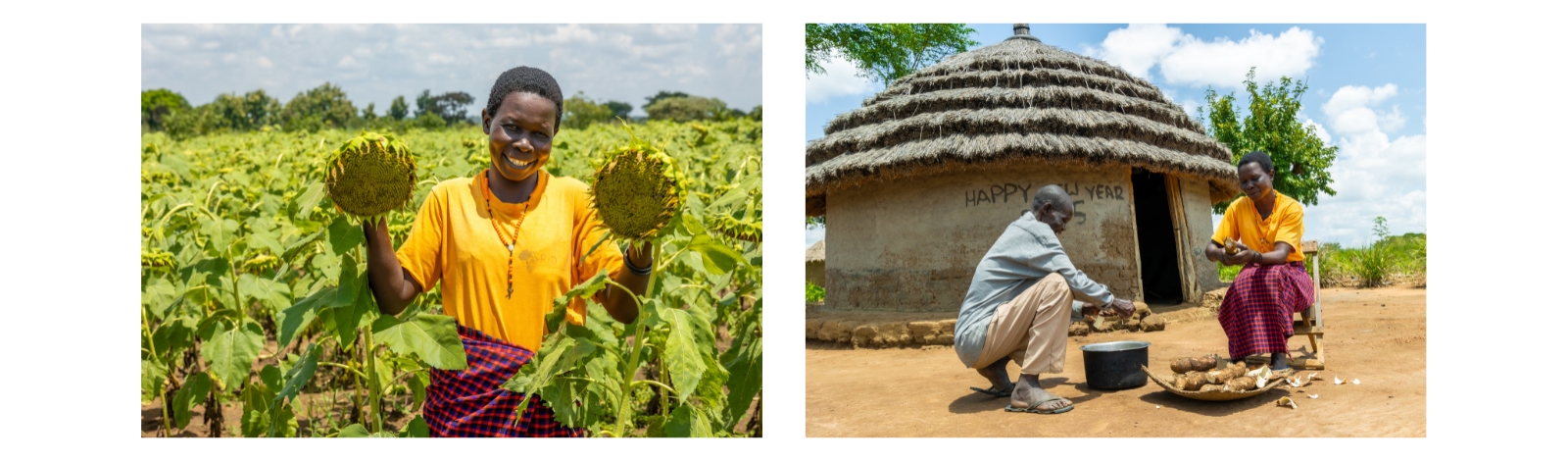
Jackline’s chance came through the Lapyem Wang Kiti Producer Group, where she learned to plant earlier, to use sunflower seed bred to mature quickly and withstand drought, and to dry and store her harvest under tarpaulins and in sealed, airtight bags so far less of it spoiled. Then she planted one acre of sunflower. She harvested 560 kilograms and sold them to a local aggregator at 2,000 shillings ($0.53) a kilo—a stable price that earned her 1.12 million shillings ($320). ‘The sunflower I planted helped me pay school fees for one of my children,’ she says. Jackline, now 38, has since expanded to five acres and mentors other women through the same shift.
In Northern Uganda, Anna Apio used to watch her cassava rot as she struggled to find buyers. Now she sells the 30 bags she grows each season to Thamini Utubora Afrika (TUA), a women-led business that mills cassava into flour and composite products. It pays her 400 shillings a kilo, nearly double the price local traders once offered. She has joined its savings group, where members borrow against the coming harvest rather than from a moneylender. The flour reaches buyers in Kenya, Europe and North America, and Anna has built a permanent home for her children. ‘Cassava is not only food,’ she says. ‘It is a business, a school fee, and a future for us.’
In Pader and Agago, women once gathered wild shea nuts that earned them almost nothing. Through Blessed Organic Release, they now supply a certified organic value chain that turns the nuts into Nilotica shea butter for cosmetics buyers in Europe, Asia and North America, in what the project reports as Uganda’s first certified organic shea butter export. The local price of that butter has risen from 25,000 to 45,000 shillings a kilo. The women who gather the nuts now earn a steady income, enough for several of them to cover school and university fees. They hold bank accounts in their own names, and many now cook with fuel briquettes made from pressed shea waste, rather than charcoal.
Nancy Abalo, a 23-year-old shea collector, has been trained in processing and soap making. While Nancy was writing her final school exams, she sold six sacks of shea nuts to Blessed Organic. ‘With that income, I paid my tuition and even supported my siblings,’ Nancy shared. ‘Now I’m studying Development Management at Gulu University and working part-time with Blessed Organics – the company that believed in me and got me here.’
In Kotido, Maria Lokure leads the Kalo Supa Farmers’ Group, once shut out of good seed and reliable buyers. The project linked her members to Agrimarks Farm Supplies, where they gained drought-tolerant seed on credit terms designed for women, along with training, aggregation services, and a route to regional markets for sesame, groundnuts, sunflower and soybeans. The once scattered, independent farm plots now produce as one coordinated supply. ‘We don’t just farm for ourselves anymore,’ Maria says. ‘We farm for markets.’
At Abim West Farmers’ Cooperative, where seven in ten members are women, farmers pool their harvests to reach institutional buyers such as the World Food Programme, local boarding schools and processors. With connections made through the STAR project, they also gained climate-smart seeds and a crop insurance pilot the cooperative hopes to extend to every member. The insurance has already paid out UGX 119 million ($32,000) in compensation, easing farmers’ risk and helping drive the cooperation’s commercial growth. It reports output up twelvefold since the pooling began, and women now sit on its board. As manager Susan Karungi puts it, buying from Abim West Farmers’ Cooperative doesn’t just support famers – it helps transform a community once known for cattle rustling into one of prosperous farmers.
With training, producer groups, and buyers at the end of value chains, the STAR project addresses one gap that the International Year of the Woman Farmer was created to highlight. When rural women reach markets, they stop farming to survive and start farming to sell.
In 2026, the United Nations marks the International Year of the Woman Farmer, and one of the gaps it was created to spotlight is this: women feed nations but rarely earn from the markets that set prices. Under ITC’s STAR Uganda project, five women from the country’s north show what changes when they can reach those markets for themselves.
Jackline’s chance came through the Lapyem Wang Kiti Producer Group, where she learned to plant earlier, to use sunflower seed bred to mature quickly and withstand drought, and to dry and store her harvest under tarpaulins and in sealed, airtight bags so far less of it spoiled. Then she planted one acre of sunflower. She harvested 560 kilograms and sold them to a local aggregator at 2,000 shillings ($0.53) a kilo—a stable price that earned her 1.12 million shillings ($320). ‘The sunflower I planted helped me pay school fees for one of my children,’ she says. Jackline, now 38, has since expanded to five acres and mentors other women through the same shift.
In Northern Uganda, Anna Apio used to watch her cassava rot as she struggled to find buyers. Now she sells the 30 bags she grows each season to Thamini Utubora Afrika (TUA), a women-led business that mills cassava into flour and composite products. It pays her 400 shillings a kilo, nearly double the price local traders once offered. She has joined its savings group, where members borrow against the coming harvest rather than from a moneylender. The flour reaches buyers in Kenya, Europe and North America, and Anna has built a permanent home for her children. ‘Cassava is not only food,’ she says. ‘It is a business, a school fee, and a future for us.’
In Pader and Agago, women once gathered wild shea nuts that earned them almost nothing. Through Blessed Organic Release, they now supply a certified organic value chain that turns the nuts into Nilotica shea butter for cosmetics buyers in Europe, Asia and North America, in what the project reports as Uganda’s first certified organic shea butter export. The local price of that butter has risen from 25,000 to 45,000 shillings a kilo. The women who gather the nuts now earn a steady income, enough for several of them to cover school and university fees. They hold bank accounts in their own names, and many now cook with fuel briquettes made from pressed shea waste, rather than charcoal.
Nancy Abalo, a 23-year-old shea collector, has been trained in processing and soap making. While Nancy was writing her final school exams, she sold six sacks of shea nuts to Blessed Organic. ‘With that income, I paid my tuition and even supported my siblings,’ Nancy shared. ‘Now I’m studying Development Management at Gulu University and working part-time with Blessed Organics – the company that believed in me and got me here.’
In Kotido, Maria Lokure leads the Kalo Supa Farmers’ Group, once shut out of good seed and reliable buyers. The project linked her members to Agrimarks Farm Supplies, where they gained drought-tolerant seed on credit terms designed for women, along with training, aggregation services, and a route to regional markets for sesame, groundnuts, sunflower and soybeans. The once scattered, independent farm plots now produce as one coordinated supply. ‘We don’t just farm for ourselves anymore,’ Maria says. ‘We farm for markets.’
At Abim West Farmers’ Cooperative, where seven in ten members are women, farmers pool their harvests to reach institutional buyers such as the World Food Programme, local boarding schools and processors. With connections made through the STAR project, they also gained climate-smart seeds and a crop insurance pilot the cooperative hopes to extend to every member. The insurance has already paid out UGX 119 million ($32,000) in compensation, easing farmers’ risk and helping drive the cooperation’s commercial growth. It reports output up twelvefold since the pooling began, and women now sit on its board. As manager Susan Karungi puts it, buying from Abim West Farmers’ Cooperative doesn’t just support famers – it helps transform a community once known for cattle rustling into one of prosperous farmers.
With training, producer groups, and buyers at the end of value chains, the STAR project addresses one gap that the International Year of the Woman Farmer was created to highlight. When rural women reach markets, they stop farming to survive and start farming to sell.
About STAR Uganda
Strengthening Agribusiness Resilience and Competitiveness (STAR) operates across 10 districts in Northern and Northeastern Uganda, focusing on shea, cassava and oilseeds value chain. The project addresses the key challenges faced by SMEs and smallholder farmers in Uganda including limited market access, constrained access to finance, low bargaining power, high post-harvest losses, and increasing exposure to climate variability and shocks. STAR works with SMEs, producer groups, business support organizations, financial institutions, service providers, and policymakers to create more efficient, resilient, and market-oriented value chains. Through its integrated approach—linking enterprise growth, farmer capability, environmental sustainability, and resilience—STAR contributes to a more competitive and connected agribusiness landscape. Local enterprises are better positioned to drive transformation, farming households share in the gains, and markets function more effectively for people, communities, and the broader economy.